Best Continuous Glucose Monitors of 2026 for Non-Diabetics (Stelo vs Lingo vs Levels)
A continuous glucose monitor is a small sensor worn on the arm that estimates your blood sugar every few minutes and sends the reading to your phone. They were built for people with diabetes, but since the FDA cleared the first over-the-counter models in 2024, healthy people have been buying them to see how food, exercise and sleep affect their glucose. The honest answer is that they are genuinely useful for learning how your body responds to meals, and genuinely overkill if you just want a number.
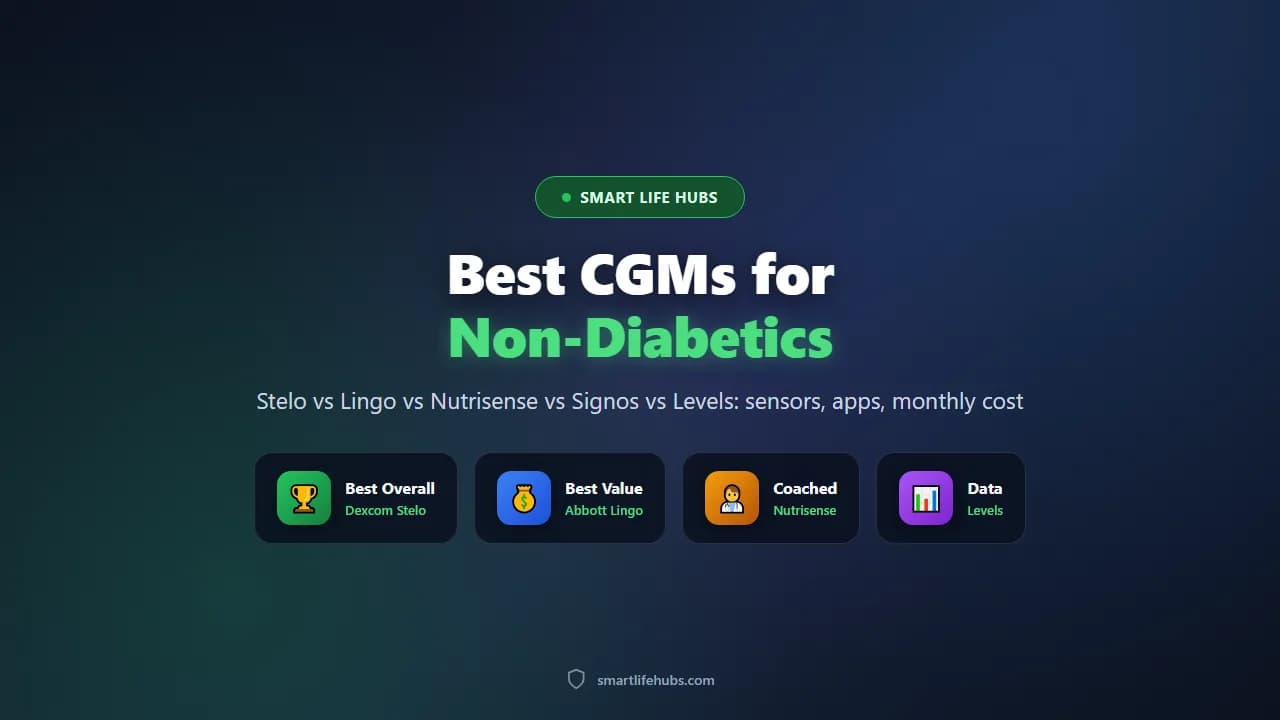
The category splits three ways. Dexcom Stelo and Abbott Lingo sell sensors over the counter with their own apps, at roughly $89 to $99 a month. Coached programmes such as Nutrisense and Signos bundle a sensor with dietitian support for about $150 to $250 a month. Levels sells a data-first app layer on top of the same sensors. Prices per sensor run from about $54 to $99, with each lasting 14 to 15 days.
I pulled BetterVitals’ and Recovery Stack’s comparisons, Knowledgelib’s model table, the FDA’s clearance notices, and each company’s pricing. Where a figure is a claim rather than a measurement, I say so. Prices are US street prices as of November 2026.
At a glance
| Product | Best for | Key specs | Price |
|---|---|---|---|
| Dexcom Stelo | Best overall | 15-day sensor, OTC, Stelo app, Oura and Apple Health sync | $89 to $99 a month |
| Abbott Lingo | Best value | 14-day sensor, OTC, Lingo app, lowest single-sensor price | $54 one sensor, $89 two, $249 six |
| Nutrisense | Best coached programme | Two sensors a month, dietitian access, AI logging | About $152 to $212 a month |
| Signos | Best for weight loss | Two sensors a month, AI app, dietitian chat | $169 to $299 a month |
| Levels | Best for data maximalists | Membership app, Stelo sensors as an add-on, lab panels | $15 a month app, Core $399 a year |
The best CGMs for non-diabetics in 2026
1. Dexcom Stelo, best overall
The Dexcom Stelo is $89 a month on subscription or about $99 for a two-sensor pack, needs no prescription, and each sensor lasts 15 days, which is the longest wear of any over-the-counter option. It was the first OTC CGM the FDA cleared, for adults 18 and over who do not use insulin, and in June 2026 the clearance extended to children aged two and older. The app shows glucose every 15 minutes with trends and an AI coach, and it integrates with Oura, Apple Health and Google Fit, which is the best ecosystem support here. Independent comparisons consistently rank it first on accuracy and wear time, with reported MARD between roughly 8 and 12 percent depending on the source. The trade-offs are that the app is less rich than the coaching programmes and you will pay more than Lingo for the same months of data.
- Pros: 15-day sensors; no prescription or subscription; best integrations; longest wear
- Cons: App is basic compared with coaching programmes; pricier than Lingo
Check today’s price on Amazon.
2. Abbott Lingo, best value
The Abbott Lingo is the cheapest way into continuous glucose monitoring. A single 14-day sensor is $54, two are $89 and six are $249 on a 12-week plan, which works out to about $91 a month on an ongoing plan. Like the Stelo it is over the counter, needs no prescription and is intended for adults 18 and over who are not on insulin. The Lingo app logs meals and shows weekly patterns, and its Lingo Count score is more beginner-friendly than the raw numbers the Stelo app presents. The trade-off is a day less wear per sensor and a smaller integration ecosystem, so if you already use an Oura ring or Apple Health as your hub, the Stelo fits better.
- Pros: $54 single sensor; no prescription; beginner-friendly app; lowest entry cost
- Cons: 14-day wear; fewer integrations than Stelo
Check today’s price on Amazon.
3. Nutrisense, best coached programme
Nutrisense costs from about $152 a month on a six-month plan and about $212 month to month, and that includes two Stelo sensors a month, the Nutrisense app, an AI assistant and one-to-one video calls with a registered dietitian. It is the pick if you want someone to interpret the data with you rather than staring at a graph and guessing. The sensor hardware is the same Dexcom Stelo you can buy for less, so what you are paying for is the human support and the structured programme. The trade-off is the cost, which is three times the price of the sensor alone.
- Pros: Dietitian support; two sensors a month; structured interpretation
- Cons: About $152 to $212 a month; same hardware as cheaper options
Check today’s price on Amazon.
4. Signos, best for weight loss
Signos costs $169 to $299 a month depending on plan length, and it bundles two 15-day Stelo sensors a month with an AI app and dietitian chat. It is aimed squarely at people trying to lose weight, and its plans sit alongside Signos+ options that add compounded GLP-1 prescribed by clinicians where that is appropriate. The trade-offs are the price at the top of the coaching range and a six-month commitment for the best rate, which makes it a bigger decision than buying a sensor outright.
- Pros: Two sensors a month; AI alerts; weight-loss focus; dietitian chat
- Cons: $169 to $299 a month; long commitment for best pricing
Check today’s price on Amazon.
5. Levels, best for data maximalists
Levels is the odd one out because it is mostly software. The app membership costs $15 a month or $80 a year, with sensors bought separately at $89 a shipment or $99 for a two-pack, and the Core tier at $399 a year includes a month of Stelo sensors plus two lab panels while Complete at $1,329 a year includes two months of sensors and unlimited coaching. It suits people who want deep metabolic scoring, historical trend search and lab work alongside the sensor data. The trade-off is that the total cost climbs fast and the company restructured its pricing in 2026, so check the current tier before you commit.
- Pros: Deep analytics; lab panels; sensor flexibility; no long commitment on the base plan
- Cons: Costs stack up; pricing changed in 2026; sensors sold separately
Check today’s price on Amazon.
What to expect from your first month
The first two weeks are the interesting part. Most people discover that foods they considered healthy spike their glucose sharply, while meals they thought were indulgent barely move it. That is the genuine value of the device, and it happens without any coaching. You will also see how a walk after eating flattens a spike, how poor sleep raises your baseline the next day, and how alcohol or a late meal changes the overnight trace.
By week three the novelty fades, and that is the test of whether the device is worth keeping. Some people keep running sensors for years because they enjoy the feedback loop. Others stop, having learned what they needed, and that is a perfectly good outcome for $49. If you can see yourself stopping after one month, buy the cheapest trial available rather than a year of coaching.
Two practical habits make the data much more useful. Weigh in at the same time each morning, after the same amount of sleep, so you are comparing like with like. And log meals in the app at the time you eat rather than reconstructing them later, because the pairing of a spike with a specific meal is the whole point. Two weeks of that is usually enough to change a few habits.
How to choose a CGM when you do not have diabetes
Understand the limits of the number. CGMs measure glucose in interstitial fluid, not capillary blood, so there is a built-in lag of about 10 to 15 minutes compared with a fingerstick, and accuracy is reported as MARD, typically around 8 to 10 percent for current over-the-counter models. A reading is a trend, not a diagnosis, and the FDA says you should not make medical decisions from it without talking to a clinician.
Know who should not use one at all. The FDA states that over-the-counter CGMs are not for anyone on insulin or with problematic hypoglycaemia, because the devices are not designed to alert you to a dangerous low. They are also not for people on dialysis, and the FDA advises anyone with a history of disordered eating to speak to a healthcare provider before using one.
Decide whether you want data or coaching. If you are self-directed and comfortable interpreting graphs, a Stelo or Lingo on its own is the cheapest path. If you want someone to explain the patterns, a coached programme is worth the extra, but only if you will actually use the appointments.
Work out the real annual cost. Two sensors a month at $89 to $99 is roughly $1,100 a year for a bare sensor plan, and coaching programmes run $1,800 to $3,000 a year. A two-week Lingo trial at $49 is the sensible way to find out whether you will look at the data before you commit to a year.
Have a plan for what you will do with the information. The value comes from seeing how specific meals affect you and adjusting accordingly. If you will not change what you eat, the data is entertainment, and $1,000 a year is a lot to pay for curiosity.
Think about the psychological risk. Continuous data can become compulsive. If you find yourself anxious about normal post-meal spikes, or restricting food to keep a flat line, stop using it. The FDA explicitly flags disordered eating as a reason to talk to a professional first.
Check whether you can use pre-tax money. Many of the over-the-counter services are listed as HSA or FSA eligible, but several are conditional or not offered, so check your plan before you pay. If you can fund it pre-tax, the effective cost of a $99 monthly plan drops meaningfully.
Compare like with like on the sensor, not the brand. Nutrisense and Signos both ship the same Dexcom Stelo hardware you can buy yourself for less, so the difference is entirely the software and the coaching. If you buy a programme and then decide you only wanted the data, you can usually switch to the bare sensor and keep your history in Apple Health.
Think about the rest of the health stack. A CGM pairs naturally with other tracking. Our smart scale roundup covers body composition, and our sleep gadget guide covers the recovery side.
Frequently asked questions
Frequently Asked Questions
6No, if you buy an over-the-counter model. Dexcom Stelo and Abbott Lingo are both cleared for adults 18 and over who do not use insulin, with no prescription. Prescription sensors such as the Dexcom G7 and FreeStyle Libre 3 Plus still require a prescription and are usually covered by insurance for people with diabetes.
The Dexcom Stelo for most people, because of its 15-day wear, no subscription and the best integrations. The Abbott Lingo is the best value at $54 for a single sensor.
Roughly $89 to $99 a month for a bare sensor plan with two sensors. Coached programmes run from about $152 to $299 a month, and Levels charges $15 a month for the app with sensors on top.
They are accurate enough for trends but not clinical grade. Interstitial readings lag blood glucose by 10 to 15 minutes, and MARD sits around 8 to 10 percent, so a single number matters less than the pattern over days.
It can, indirectly, by showing you which meals spike your glucose and which do not. Signos is built around that use case, but the behaviour change is still yours, and the evidence for CGM-guided weight loss in people without diabetes is limited.
Anyone on insulin, anyone with problematic hypoglycaemia, people on dialysis, and anyone with a history of disordered eating should talk to a healthcare provider first, according to the FDA.
The bottom line
Buy the Dexcom Stelo if you want the best all-round CGM: 15-day sensors, no prescription, no subscription and the strongest app integrations at $89 to $99 a month. Buy the Abbott Lingo if you want the cheapest way in, at $54 for a single 14-day sensor. Buy Nutrisense if you want a dietitian interpreting the data with you, Signos if you are focused on weight loss, and Levels if you want the deepest analytics and lab work. The FDA’s clearance notice for the first over-the-counter CGM sets out the limits plainly: these devices are for people not on insulin, they are not for problematic hypoglycaemia, and you should not make medical decisions from them alone. Try a two-week Lingo first if you are unsure, because the data is only useful if you will act on it. Which one fits your goal? Tell us in the comments.