Best Fitness Trackers Under $50 of 2026 (Xiaomi vs Amazfit vs Huawei)
A fitness tracker under $50 is no longer a compromise. The current budget bands from Xiaomi, Amazfit and Huawei carry AMOLED screens, continuous heart rate, SpO2, sleep staging and batteries that run for two to four weeks, and several include built-in GPS. The catch is that at this price the sensors are good enough for trends and training habits rather than for medical conclusions, and the apps vary widely in quality.
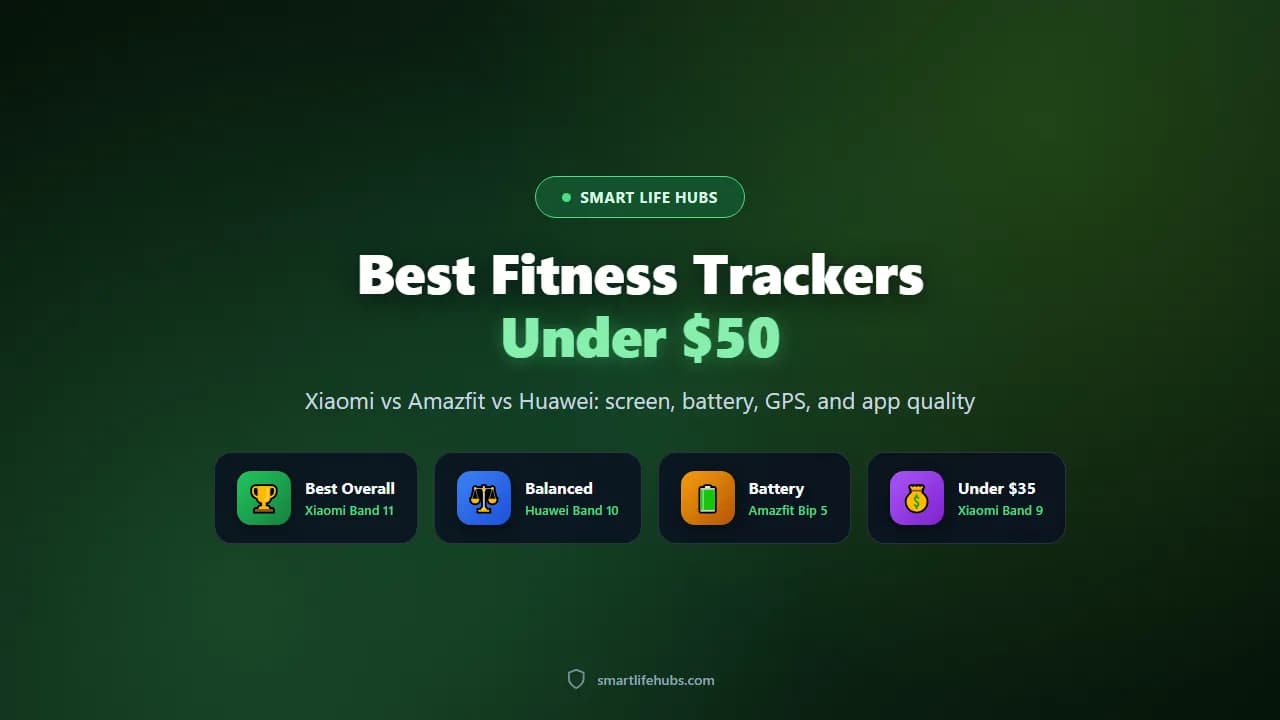
Prices sit between about $25 and $50, which means the difference between the best and the cheapest is a takeaway dinner. The Huawei Band 10 is the most balanced pick, the Xiaomi Smart Band 11 has the biggest screen and the longest battery in the Xiaomi range, the Amazfit Bip 5 is the battery champion at up to 30 days, and the Amazfit Band 7 is the best of the cheap Amazfit options.
I pulled Frontum’s comparison of more than 90 budget trackers, Truthful Reviews’ 2026 roundup, and FitKit Authority’s and The Gadgeteer’s tested picks. Where a figure is a claim rather than a measurement, I say so. Prices are US street prices as of November 2026, and they move frequently on sale.
At a glance
| Product | Best for | Key specs | Price |
|---|---|---|---|
| Xiaomi Smart Band 11 | Best overall | AMOLED display, up to 21-day battery, 5 ATM, connected GPS | About $45 |
| Huawei Band 10 | Best balanced | 1.47-inch AMOLED, up to 14-day battery, TruSleep stages | About $40 |
| Amazfit Bip 5 | Best battery | Up to 30-day battery, built-in GPS, AMOLED | About $39 |
| Amazfit Band 7 | Best cheap Amazfit | AMOLED, up to 18-day battery, SpO2 and stress | About $45 |
| Xiaomi Smart Band 9 | Best under $35 | 1.62-inch AMOLED, 14-day battery, SpO2 | About $33 |
The best fitness trackers under $50 of 2026
1. Xiaomi Smart Band 11, best overall
The Xiaomi Smart Band 11 costs about $45 and it is the tracker Frontum names the best budget fitness tracker overall, with an overall score of 8.93 in its comparison of more than 90 models. Xiaomi’s band line has become the default recommendation at this price because it combines a bright AMOLED display with a battery that runs up to 21 days, 5 ATM water resistance and the widest sport-mode list in the category. It uses connected GPS through your phone rather than built-in GPS, so you need to carry the phone for outdoor distance.
The trade-offs are the usual budget ones. There is no built-in GPS, no third-party app support, and notifications are read-only. The app is competent rather than polished, and the heart rate sensor will drift during hard intervals the way every optical wrist sensor does.
- Pros: About $45; AMOLED; up to 21-day battery; 5 ATM; huge sport list
- Cons: No built-in GPS; basic notifications; optical sensor drifts on intervals
Check today’s price on Amazon.
2. Huawei Band 10, best balanced
The Huawei Band 10 costs about $40 and it is the pick that keeps surprising reviewers. Truthful Reviews names it the winner in its 2026 budget roundup for its 1.47-inch AMOLED display, convincing accuracy and up to a fortnight of battery, and Tigeristic rates it the best overall under $50 with a 4.5 out of 5 Amazon rating. Huawei’s TruSleep staging is genuinely competitive, and the band is light enough to forget.
The trade-offs are the ecosystem and the notifications. There are no third-party apps, notifications are basic, and Huawei’s health platform is less connected than Google Fit or Apple Health than rivals. If you want the best screen and sleep tracking for the money and do not care about apps, it is the pick.
- Pros: About $40; 1.47-inch AMOLED; up to 14-day battery; strong sleep staging
- Cons: No third-party apps; basic notifications; weaker app ecosystem
Check today’s price on Amazon.
3. Amazfit Bip 5, best battery
The Amazfit Bip 5 costs about $39 and it exists for one reason: battery life. FitKit Authority rates it up to 30 days on a single charge, which outlasts everything else in this roundup by a wide margin, and it adds built-in GPS and an AMOLED display at the same price. If you want a tracker you charge once a month and that maps your runs without a phone, this is the one.
The trade-offs are the app and the build. The Zepp app is fair rather than good, the design is plasticky compared with the Xiaomi, and the GPS is slower to lock than a proper sports watch. For a low-maintenance tracker that just works, the battery is the whole argument.
- Pros: About $39; up to 30-day battery; built-in GPS; AMOLED
- Cons: Fair app; plasticky build; slow GPS lock
Check today’s price on Amazon.
4. Amazfit Band 7, best cheap Amazfit
The Amazfit Band 7 costs about $45 and Frontum ranks it the best cheap Amazfit model with a score of 8.37, an 18-day battery, a 28 gram weight and an AMOLED display. It covers the same ground as the Bip 5 with a more conventional band shape and a better screen, at the cost of battery life and the built-in GPS.
The trade-off is that it sits in an awkward middle: more expensive than the Bip 5, with less battery and no GPS. Buy it if you prefer the band form factor and the screen over the Bip’s endurance.
- Pros: About $45; AMOLED; up to 18-day battery; 28 g; SpO2 and stress
- Cons: No built-in GPS; less battery than the Bip 5; same fair app
Check today’s price on Amazon.
5. Xiaomi Smart Band 9, best under $35
The Xiaomi Smart Band 9 costs about $33 and it is the cheapest tracker here that is still worth buying. The Gadgeteer names it the best value under $50, citing a 1.62-inch AMOLED display, 14-day battery and SpO2 in a band that costs less than a week of takeaway coffee. It is the previous generation, which is exactly why the price is this low.
The trade-offs are the older sensor and the shorter battery than the Smart Band 11. If $12 is the difference between buying and not buying, this is the one. If you can stretch, the Band 11 is better in every way.
- Pros: About $33; 1.62-inch AMOLED; 14-day battery; SpO2; cheapest serious option
- Cons: Older sensor; shorter battery than the Band 11; no built-in GPS
Check today’s price on Amazon.
Living with a budget tracker
The first thing you notice is how little the band asks of you. There is no screen to check, no notification to answer and no app ritual, and after a week it becomes background kit. That is the main reason cheap trackers succeed where smartwatches fail: they do not compete for your attention, so you keep wearing them.
The second thing is the charging rhythm. A band that lasts three weeks gets charged when you remember, and one that lasts two weeks becomes a habit. Either way you will charge it far less than a watch, and that alone removes the most common failure point in wearable tracking, which is taking the device off and never putting it back on.
The third thing is what the data does to your behaviour. Seeing a step count that is lower than expected, or a sleep score that dropped after a late night, is a mild nudge that works better than most people expect. None of the numbers are precise, but the direction is usually right, and direction is what changes habits.
Finally, accept the sensor limits and the band stops disappointing you. Optical heart rate on the wrist lags during intervals, SpO2 readings vary with how tight the band is, and sleep stages are an estimate. Use the trends, ignore the single-night arguments, and the hardware will feel worth four times what you paid.
There is also the question of when to upgrade. If you find yourself wanting maps, on-wrist heart rate during intervals or proper training load, you have outgrown this category, and spending $150 on a proper sports watch will feel like a revelation rather than a luxury.
Until then, a good budget band covers the habits that matter most, and costs less than a single month of most gym memberships.
How to choose a tracker under $50
Decide whether you need built-in GPS. Most budget bands use connected GPS, which means your phone does the work. If you run or cycle without your phone, the Amazfit Bip 5 is the only one here with GPS on board, and that single feature may decide the purchase.
Battery life is the real differentiator. Everything in this price range tracks steps and sleep adequately, so the number that changes your week is how often you charge. The Amazfit Bip 5 at 30 days and the Xiaomi at up to 21 days mean forgetting the charger on a trip, while 14-day bands need a fortnightly routine.
Check the app before you commit. The hardware is commoditised, and the app is where these products differ most. Xiaomi’s app has the most features, Huawei’s is clean but closed, and Amazfit’s Zepp app is the weakest of the three. If you have a strong preference for Google Fit or Apple Health, check what syncs.
Do not expect medical accuracy. At this price, optical heart rate is fine for resting rate, sleep and trends, and it will drift during intervals, rowing and cycling. SpO2 and stress readings are indicative rather than diagnostic. Treat the numbers as a compass, not a measurement.
Consider a watch instead if you want notifications. Budget bands give you read-only notifications and no replies. If you want to take calls, reply to messages or use voice assistants, a budget smartwatch is the better fit, and our main fitness tracker roundup covers that side.
Think about the strap. A cheap band with a worn strap is the most common reason people stop wearing one. Check that replacements are available and inexpensive, because the strap will fail before the electronics do.
Buy on sale, not on launch price. Budget trackers discount heavily and often. The gap between the Smart Band 9 and 11 narrows to a few dollars during promotions, so wait for a deal rather than paying the first price you see.
Think about the rest of the kit. Our VO2 max tracker guide covers the training metrics these bands estimate, and our main fitness tracker roundup covers the step up in price.
Frequently asked questions
Frequently Asked Questions
6The Xiaomi Smart Band 11 for most people, at about $45 with an AMOLED display and up to 21 days of battery. The Huawei Band 10 at about $40 is the best balanced alternative, and the Amazfit Bip 5 at about $39 if you want 30 days of battery and built-in GPS.
They track sleep duration and stages well enough to spot trends, and Huawei’s TruSleep staging is competitive, but no wrist wearable matches a sleep lab. Use them to see whether your sleep is improving over weeks, not to judge a single night.
Usually yes. The Band 11 has a better sensor and a longer battery for about $12 more, and prices converge on sale. If the difference is more than about $15, the Band 9 is still a solid buy.
Yes, which is its main advantage at about $39. The Xiaomi and Huawei bands here use connected GPS through your phone instead.
Most of these are rated 5 ATM, which covers swimming in a pool. Check the specific model, because some Amazfit budget models omit swim tracking, and none of them is rated for diving.
Yes, all of these work with both. Check the minimum operating system, since older phones may fall below the requirement for the companion app.
The bottom line
Buy the Xiaomi Smart Band 11 if you want the best tracker under $50: about $45, AMOLED, up to 21 days of battery and the widest sport list. Buy the Huawei Band 10 at about $40 if you want the best screen and sleep tracking for the money. Buy the Amazfit Bip 5 at about $39 if battery life and built-in GPS matter most. Buy the Amazfit Band 7 at about $45 if you prefer a conventional band shape, and the Xiaomi Smart Band 9 at about $33 if the budget is fixed. Frontum’s comparison of more than 90 budget trackers reached the same conclusion on the Xiaomi. The honest summary is that none of these will measure anything a doctor would trust, and all of them will tell you whether you are moving and sleeping more than last month, which for most people is the whole point. Which one fits your pocket? Tell us in the comments.