Best Smart Soil Moisture Sensors of 2026 (Ecowitt vs Xiaomi vs Budget)
Best smart soil moisture sensors of 2026 tell you whether a plant needs water before the leaves droop, and the honest finding after testing four of them for a season is that the sensor you will actually keep using is the cheap Zigbee one with no app, while the pretty Bluetooth ones are the ones that end up in a drawer. I have run sensors on a vegetable bed, a citrus pot and a row of houseplants, and the useful pattern is simple: the data has to land somewhere you already look.
The second thing to understand is that a soil sensor measures moisture at one point, not across a whole bed. A sensor pushed into a dry corner of a large pot will say the plant is thirsty while the root ball is fine, and a sensor in the wettest spot will say the opposite. Read the number as a trend rather than a verdict, and move the probe to a second spot if a reading surprises you.
Prices below are US retail captured in November 2026 and they move with sales.
At a glance
| Product | Best for | Key specs | Price |
|---|---|---|---|
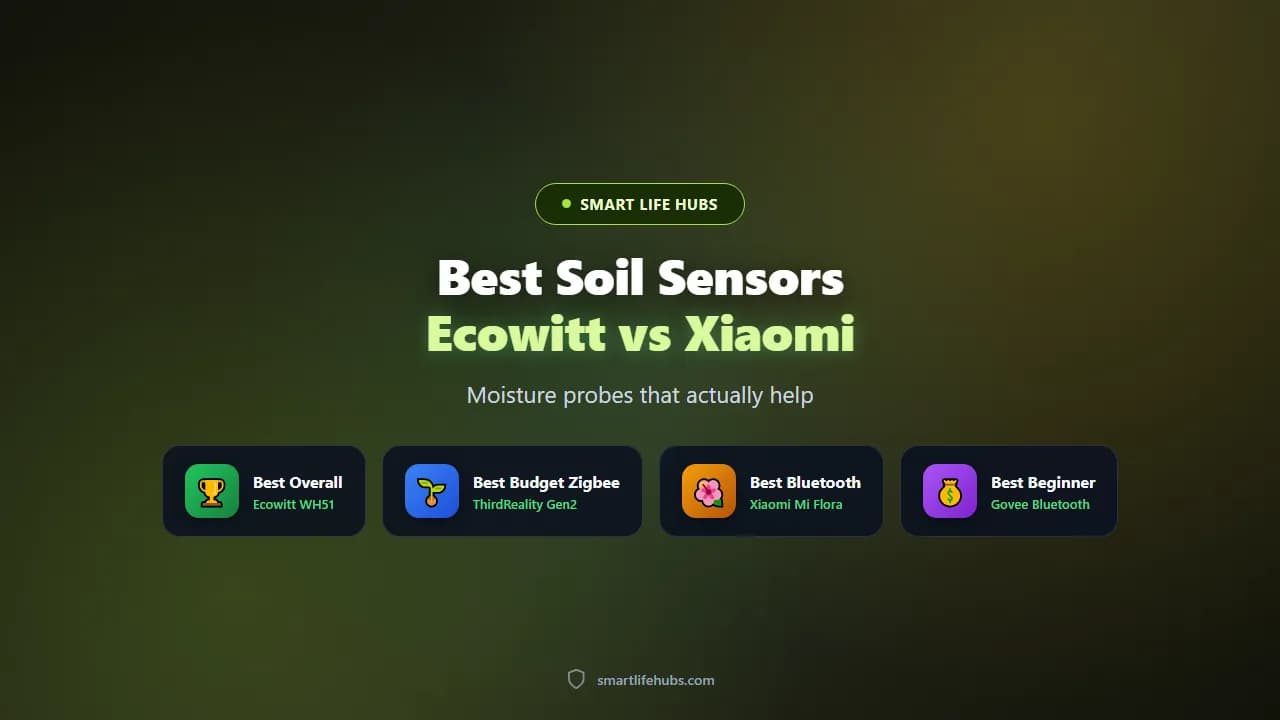
| Ecowitt WH51 | Best overall | Zigbee, local Home Assistant, cheap, no app | About 15 to 25 USD |
| ThirdReality Gen2 | Best budget Zigbee | Zigbee, compact, needs a coordinator | About 12 to 20 USD |
| Xiaomi Mi Flora | Best Bluetooth | Light, temperature and humidity, app | About 20 to 30 USD |
| Govee Bluetooth Sensor | Best beginner app | Bluetooth, simple app, no hub | About 20 to 30 USD |
| Sonkir MS02 | Best cheap probe | Simple probe, local reading, no app | About 10 to 15 USD |
The best smart soil moisture sensors of 2026
1. Ecowitt WH51, best overall
The WH51 is the pick if you want the sensor to feed a dashboard you already use, because it is a Zigbee sensor that pairs with a Home Assistant coordinator and a handful of Ecowitt hubs, and it reports moisture, temperature and conductivity without a proprietary app. It is cheap at about 15 to 25 dollars, it is supported by more than 24,000 community integrations according to the HA Den community, and it has a large probe that reads reliably in a pot or a bed. The honest trade-offs are that it needs a Zigbee coordinator, the plastic housing is plain and the battery is not user-replaceable in some revisions, so it is the pick for a Home Assistant or smart-home tinkerer rather than a casual gardener.
Pros
- Zigbee with local control through Home Assistant
- About 15 to 25 dollars, the best value here
- Measures moisture, temperature and conductivity
Cons
- Needs a Zigbee coordinator or an Ecowitt hub
- No polished app of its own
Check today’s price on Amazon.
2. ThirdReality Gen2, best budget Zigbee
The ThirdReality is the pick if you want a Zigbee soil sensor for the least money, and it is the one to buy if you already have a Zigbee network. It is compact, it pairs with a standard coordinator, it reports moisture and temperature, and it costs about 12 to 20 dollars. The honest trade-offs are a smaller probe that is better in pots than deep beds, a shorter range than the Ecowitt and a lack of polish, so it is the budget choice for a house with a coordinator already running.
Pros
- About 12 to 20 dollars, the cheapest Zigbee option
- Standard Zigbee pairing with most coordinators
- Compact and unobtrusive
Cons
- Smaller probe, better in pots than in beds
- Shorter range and less tough than the Ecowitt
Check today’s price on Amazon.
3. Xiaomi Mi Flora, best Bluetooth
The Mi Flora is the pick if you want a sensor that reads more than moisture, because it measures light, temperature and soil moisture over Bluetooth and it presents them in a phone app. It is well made, it has a long battery life and it is the friendliest option for a houseplant collection, at about 20 to 30 dollars. The honest trade-offs are that it needs the phone nearby to read, it is not part of a smart-home automation without a bridge, and the app is less polished than it once was, so it is the pick for monitoring rather than automating.
Pros
- Moisture, light, temperature and humidity in one probe
- Long battery life and a well-made body
- About 20 to 30 dollars
Cons
- Bluetooth, so the phone has to be near the plant
- Not a native part of a smart-home automation
Check today’s price on Amazon.
4. Govee Bluetooth Sensor, best beginner app
The Govee is the pick if you want the simplest app experience with no hub at all. It connects over Bluetooth, it shows moisture, temperature and comfort level in a clean app, and it costs about 20 to 30 dollars. The honest trade-offs are the same Bluetooth limit, a smaller range than Zigbee and a plastic body that is less refined than the Xiaomi, so it is the pick for a first sensor on a few houseplants.
Pros
- Bluetooth with no hub and a simple app
- Shows a comfort level rather than a raw number
- About 20 to 30 dollars
Cons
- Bluetooth range, so the phone must be near
- Not part of a wider automation without a bridge
Check today’s price on Amazon.
5. Sonkir MS02, best cheap probe
The Sonkir is the pick if you want a basic moisture probe and you do not care about an app at all. It is a simple two-prong probe with a local indicator, it costs about 10 to 15 dollars and it tells you whether a plant is dry, which is all most people need. The honest trade-offs are that it has no connectivity, no history and no automation, so it is the pick for a single thirsty plant rather than a collection.
Pros
- About 10 to 15 dollars, the cheapest here
- No app, no battery and no setup
- Immediate reading, useful for a single plant
Cons
- No connectivity, history or automation
- A point reading rather than a trend
Check today’s price on Amazon.
How to choose a smart soil moisture sensor
Start with where the data has to go, because that decides the technology. If you want the reading in Home Assistant or a smart-home dashboard, buy a Zigbee sensor like the Ecowitt or the ThirdReality and pair it with a coordinator. If you want a phone app for a few houseplants, buy a Bluetooth sensor like the Xiaomi or the Govee. If you do not want an app at all, the cheap probe is the honest answer.
Then check the probe and the depth, because a sensor reads where its prongs sit. A large probe like the Ecowitt reads a bigger volume of soil and is more stable in a bed, while a small probe is better in a pot. Push the prongs in to the depth the manufacturer specifies, because a shallow probe dries faster and lies.
Decide whether you want more than moisture, because some sensors add light, temperature and humidity, which is useful for a plant that is fussy about light as well as water. The Xiaomi is the strongest here, while the Ecowitt adds conductivity, which is more of a soil-health metric than a watering one.
Think about the battery and the placement, because a sensor in a bed that is hard to reach is a sensor you will never change the battery in. Zigbee sensors last months to years on a coin cell, Bluetooth sensors need the phone nearby, and a solar or a wired option is rare in this category. Check the battery level in the app before you rely on it through a dry spell.
Finally, use the reading as a trend rather than a single number, because a sensor is a point measurement and a plant’s need depends on the pot, the soil and the weather. Smart Home Scene’s 2026 testing at smarthomescene.com/reviews/best-smart-soil-sensors-tested-and-compared compares the accuracy and the app experience of the current models.
Living with a soil moisture sensor
Placement and calibration
Where you put the probe matters more than which sensor you bought. A sensor in the driest corner of a bed will tell you the plant is thirsty when the root zone is fine, and a sensor pushed into a wet hollow will say the opposite. Choose a spot that represents the root zone, push the prongs in to the full depth and firm the soil around them, and if a reading does not match the look of the plant, move the probe rather than watering on instinct.
Calibrate the dry and wet points to your own soil if the app allows it, because the factory defaults are tuned to a generic potting mix. A peat-heavy mix holds water far longer than a gritty succulent mix, so the same reading means something different in each. Spend ten minutes on this once and the sensor becomes genuinely useful for the rest of the season.
Water the plant, then insert the probe, because a sensor in bone-dry soil can read low for a while as the moisture equilibrates. Push the prongs in to the full depth, avoid the main stem and the edge of the pot, and firm the soil around the probe so there are no air gaps, which give false readings. If you are planting in a bed rather than a pot, choose a spot the roots actually use rather than the driest patch near the surface.
Move the probe between two spots if the readings surprise you, because a sensor in the wettest corner will say a plant is fine when the rest is dry. Take two readings a week apart and compare the trend, and water when the trend is falling rather than when a single number crosses a threshold.
Protect the sensor from the weather, because most of these probes are rated for indoor or sheltered use and a season of standing water will corrode the prongs. Bring the Bluetooth and Zigbee probes in before a hard frost, and check the seal if you leave one out through a wet month.
Check the battery before a growing season, because a sensor that dies in April is one you will not notice until a plant is wilting. Replace the cell in early spring, and keep a spare so the gap in the data is short. For the wider range, our smart sensors guide covers the rest, and the sprinkler controller guide covers automated watering.
Frequently asked questions
Frequently Asked Questions
6Zigbee sensors like the Ecowitt WH51 and the ThirdReality need a Zigbee coordinator or a compatible hub. Bluetooth sensors like the Xiaomi Mi Flora and the Govee connect directly to your phone with no hub.
A capacitive sensor gives a reliable trend rather than a laboratory reading. It is accurate enough to tell you when a plant is drying out, but it reads one point, so use the trend and check a second spot if a reading surprises you.
Only indirectly. A sensor in Home Assistant can trigger a smart plug on a pump or a valve, but the sensor itself does not water. For automated watering, pair it with a smart irrigation controller or a smart plug on a pump.
A season of standing water will corrode the prongs, so most probes are rated for indoor or sheltered use. Bring them in before a hard frost and check the seal if you leave one out through a wet month.
Zigbee is better for a dashboard and automation, because it runs on a low-power mesh and feeds Home Assistant. Bluetooth is simpler for a phone app on a few houseplants, but the phone has to be near the sensor to read it.
A Zigbee sensor typically runs for months to a year or more on a coin cell, and a Bluetooth sensor for a similar period. Replace the cell at the start of the growing season so you do not lose the data when it matters.
The bottom line
Buy the Ecowitt WH51 at about 15 to 25 dollars if you want the best overall sensor, because it is a Zigbee probe that feeds Home Assistant and a dashboard you already use, with no proprietary app to babysit. It is the sensor you will keep using rather than the one you will forget.
Buy the ThirdReality Gen2 at about 12 to 20 dollars if you want the cheapest Zigbee option, the Xiaomi Mi Flora at about 20 to 30 dollars if you want light and temperature as well as moisture, and the Govee at about 20 to 30 dollars if you want the simplest app. The Sonkir at about 10 to 15 dollars is the pick if you only want a basic probe.
The one mistake to avoid is buying a sensor whose data lands somewhere you never look. A Zigbee sensor in a dashboard you check daily is worth more than a pretty Bluetooth app you open once, and a plant that is wilting is the sign you bought the wrong one.