Fitbit Air vs Oura Ring 5: Band or Ring for Sleep Tracking?
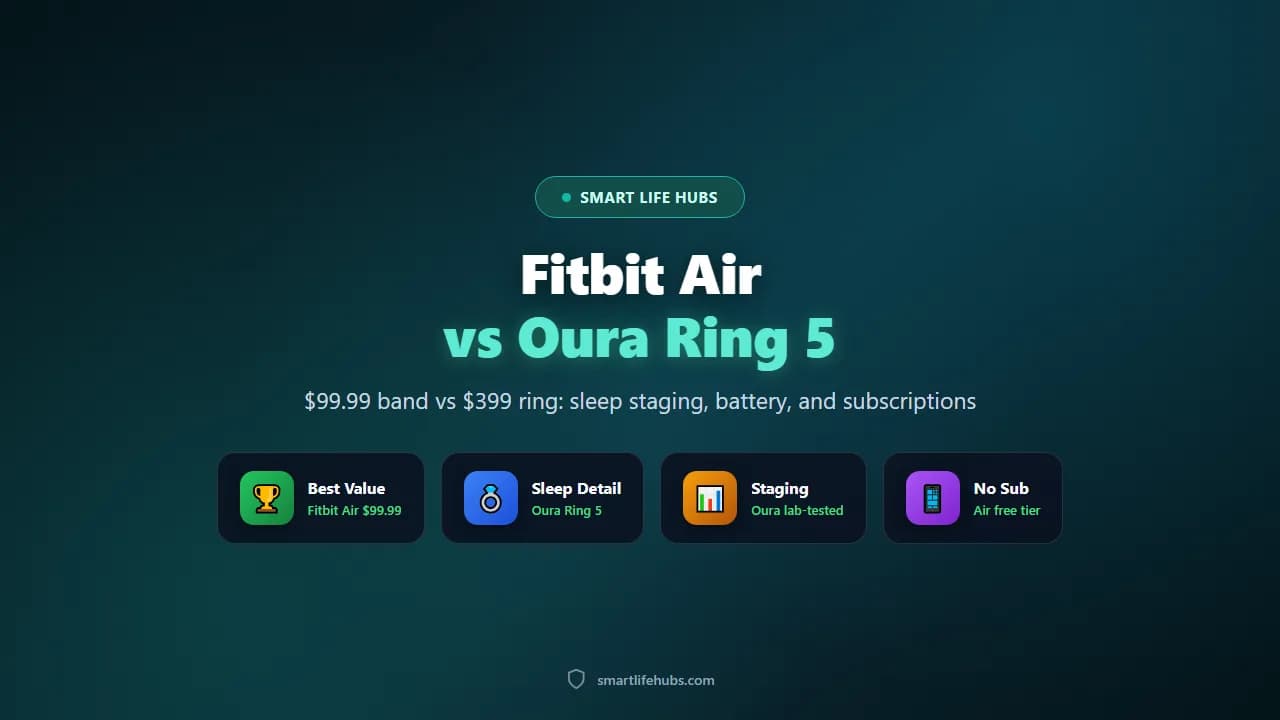
The Fitbit Air and the Oura Ring 5 both track sleep without a screen, and they disagree about almost everything else. The Air is a $99 band you wear on your wrist, works fully without a subscription and gives you sleep stages, a score, heart rate, HRV and SpO2 for free. The Oura Ring 5 is a $399 ring that requires a $5.99 monthly membership to show you most of its data, and it is the device people buy when sleep is the single thing they care about.
There is no clean winner, and the honest reason is that nobody has published a proper lab study of these two against each other. Owners who wear both usually see sleep and wake times within minutes, and the disagreement is mostly about deep sleep. If you want the cheapest reliable sleep tracker, buy the Air. If you want the most detailed sleep picture and will engage with it, the ring is better and costs four times as much.
I pulled Kudomax’s cost-of-ownership breakdown, a Brigham and Women’s Hospital lab study of earlier-generation devices, The Independent’s sleep tracker testing, and the manufacturers’ specifications. Where a figure is a claim rather than a measurement, I say so. Prices are US street prices as of November 2026.
At a glance
| Product | Best for | Key specs | Price |
|---|---|---|---|
| Fitbit Air | Best value sleep tracking | Screenless band, free sleep stages, HRV, SpO2, skin temperature | $99.99, subscription optional |
| Oura Ring 5 | Best sleep detail | Ring, 12 signal pathways, sleep staging, sleep debt, body clock | $399 to $499 plus $5.99 a month |
| Whoop 5.0 | Best for athletes | Screenless band, strain and recovery, 14-day battery with power pack | $239 a year membership |
| Garmin CIRQA | Best no-subscription band | Screenless band, 10-day battery, no membership required | $199.99 |
| Apple Watch Series 12 | Best if you want a watch | Smartwatch, FDA-authorized sleep apnea detection | From $399 |
Fitbit Air vs Oura Ring 5 head to head
Price and what you actually own
The Air costs $99.99, or $129.99 for the regular model depending on timing and retailer, and the free tier of the Google Health app includes sleep score and stages, readiness, heart rate, HRV and SpO2. Nothing essential is locked. Google Health Premium at $9.99 a month or $99.99 a year adds AI coaching and a readiness score, with three months included.
The Oura Ring 5 costs $399 in silver or black and $499 in premium finishes, and it requires an Oura Membership at $5.99 a month or $69.99 a year. Without it you get three daily scores, Readiness, Sleep and Activity, and little else, which means the detailed insights that justify the $399 sit behind the subscription. Over three years the ring costs roughly $610 to $710 with membership, against about $100 for the Air if you never subscribe.
Sleep accuracy
This is where the ring’s reputation comes from, and it holds up but not by a wide margin. Oura reports 95 percent sleep staging accuracy, though the footnote ties that figure to two-stage sleep-versus-wake scoring, and its own 2021 validation found 96 percent for sleep versus wake and 79 percent across four stages over 440 nights. Kudomax found no published lab study pitting the Air against the Ring 5 directly.
The best available evidence is a 2024 Brigham and Women’s Hospital study of earlier models, which compared an Oura Gen3, a Fitbit Sense 2 and an Apple Watch Series 8 against polysomnography in 35 adults. All three correctly flagged at least 95 percent of lab-scored sleep as sleep, but telling the stages apart was harder, with sensitivity between 50 and 86 percent. Oura’s stage estimates did not differ significantly from the lab’s, while the Fitbit overestimated light sleep by 18 minutes and underestimated deep sleep by 15.
In practical terms, one extended wearer comparison logged a 17-minute spread in total sleep across the Air, Whoop and Oura on the same night, which is normal variance for consumer wearables. Trust the trend over weeks, not any single night.
Battery and daily wear
The Air is rated for up to a week, and DC Rainmaker’s unit met that, with a full charge taking about 90 minutes and five minutes on the charger buying about a day. It stores about seven days of detailed data, so you can forget to open the app for a week. The Oura Ring 5 lasts 6 to 9 days and takes about 80 minutes to charge, but it stores only up to three days of data, so you need to open the app every couple of days or you lose history.
Both are screenless and comfortable enough to sleep in. The ring is the better choice if you dislike anything on your wrist at night, and the band is better if you want a silent vibrating alarm, which the Oura does not have.
Health features beyond sleep
The Air has the better range of incidental health features for the price: background irregular-rhythm checks for AFib, a vibration alarm, skin temperature variation and 50 metre water resistance. The ring matches it on water resistance at 100 metres and adds a dedicated digital temperature sensor rather than deriving variation from other sensors, plus sleep debt and body clock insights.
Worth knowing what the data is good for. Both devices are excellent at showing whether your sleep is trending worse over a month, whether a late night cost you, and whether you are getting enough deep sleep on average. Neither is good at telling you why, and neither can diagnose sleep apnea, restless legs or insomnia. Treat them as trend tools and take anything persistent to a doctor.
That distinction matters more than the accuracy numbers suggest. A tracker that tells you your deep sleep has fallen off for three weeks is genuinely useful. One that tells you you slept badly last night because you had a glass of wine is noise you could have worked out yourself.
Neither is a medical device. If you want FDA-authorized sleep apnea detection, that is the Apple Watch Series 12, which is a smartwatch rather than a dedicated tracker and costs from $399.
The alternatives worth knowing
The Garmin CIRQA at $199.99 is the sleeper here: a screenless band with a 10-day battery and no membership at all, which makes it the best option if you want a band and refuse to pay a subscription. Whoop at $239 a year is the pick for athletes who want strain and recovery guidance, and the Apple Watch Series 12 is the pick if you want a watch that also tracks sleep.
Living with each one
The Air disappears into your routine. You charge it roughly once a week for about an hour, and because the free app already shows sleep stages, heart rate and HRV, most owners never feel the absence of Premium. The band is light enough to forget, and the vibrating alarm is the feature you will miss if you ever go back to a phone alarm. The cost of that simplicity is that the data is shallower than the ring’s, and if you want the AI coach you are paying $9.99 a month on top.
The ring asks more of you and rewards the effort. The nightly ritual is opening the app to see your Sleep score, and because the ring only holds three days of data, skipping a couple of nights means losing history. That friction sounds like a flaw, and it is, but it also forces the habit that makes the device useful. Owners who engage with it tend to stay engaged, and owners who do not tend to wonder why they spent $399.
Sizing is the ring’s hidden risk. It comes in whole sizes 6 to 13 only, with no half sizes, and a ring that is slightly loose will rotate and produce worse data while a ring that is tight is uncomfortable for life. Order the sizing kit first and wear it for a day before you commit, because a badly fitted ring is the most common reason people abandon the category.
Both devices handle the same awkward truth: they are worn every night, so comfort decides everything. If you already sleep fine with a watch or a band, the Air is the lower-risk purchase. If you have never tolerated anything on your wrist at night, the ring is the reason to switch, and you will notice the difference immediately.
There is also the question of what happens when you stop wearing it. Both devices only work if you wear them, so the best sleep tracker is the one you will actually keep on, and that is a comfort decision rather than a specification one.
Which one should you buy?
Buy the Fitbit Air if you want the cheapest good sleep tracker. At $99.99 with free sleep stages, HRV, SpO2 and skin temperature, it covers everything most people need and never asks for a subscription. Kudomax’s three-year cost comparison makes the value case clearly.
Buy the Fitbit Air if you want a silent alarm. It has a vibration motor for haptic wake-ups, and the Oura Ring 5 has no alarm at all.
Buy the Fitbit Air if you forget to open apps. It stores about seven days of data against the ring’s three, so a week away from your phone will not cost you your history.
Buy the Oura Ring 5 if sleep is your primary goal. The 12 signal pathways, the dedicated temperature sensor, sleep debt and body clock insights give a more detailed picture, and the Brigham and Women’s study found its staging did not differ significantly from a sleep lab’s.
Buy the Oura Ring 5 if you hate wearing anything on your wrist. At 2.28 millimetres thick and from 2 grams, it is genuinely unobtrusive, and the 100 metre water rating suits swimming and showers.
Buy the Garmin CIRQA if you want a band without a subscription. At $199.99 with a 10-day battery and no membership, it is the rational middle option.
Do not buy the Oura Ring 5 if you will not pay the membership. Without it you get three daily scores and little else, which makes a $399 ring a poor purchase.
Do not buy either if you want medical-grade sleep apnea detection. That requires the Apple Watch Series 12 or a proper sleep study.
Think about the rest of the kit. Our sleep tracker roundup covers the wider field, and our no-subscription smart ring guide covers the rings that do not charge a monthly fee.
Frequently asked questions
Frequently Asked Questions
6Marginally, and mostly on staging detail. A 2024 hospital lab study found Oura’s stage estimates did not differ significantly from polysomnography while Fitbit overestimated light sleep by 18 minutes and underestimated deep sleep by 15. Owners wearing both typically see sleep and wake times within minutes.
Yes. The free Google Health app includes sleep score and stages, readiness, heart rate, HRV, SpO2 and skin temperature. Google Health Premium at $9.99 a month adds AI coaching and a readiness score.
Yes. Oura Membership costs $5.99 a month or $69.99 a year, and without it you only get three daily scores, Readiness, Sleep and Activity, rather than the detailed insights.
6 to 9 days per charge, and about 80 minutes to recharge. It stores only up to three days of data, so you need to sync every couple of days.
Up to a week, with a full charge taking about 90 minutes and a five-minute top-up giving roughly one day. It stores about seven days of detailed data.
No. The Ring 5 has no vibration alarm, while the Fitbit Air has a vibration motor for silent haptic wake-ups.
The bottom line
The Fitbit Air is the better buy for most people: $99.99, free sleep stages, HRV, SpO2 and skin temperature, a week of battery, a silent alarm and no subscription required. The Oura Ring 5 is the better sleep tracker if sleep is your main concern, with more detailed staging, a dedicated temperature sensor, sleep debt and body clock insights, but it costs $399 to $499 plus $5.99 a month and needs syncing every couple of days. Buy the Garmin CIRQA at $199.99 if you want a band with no membership, and the Apple Watch Series 12 if you want FDA-authorized sleep apnea detection. The Independent’s tested sleep tracker guide reached the same conclusion on the value question. The honest summary is that the ring is more precise and the band is far better value, and neither one will tell you something a sleep lab would not. Which matters more to you? Tell us in the comments.