Withings BodyScan 2 Review 2026: The $600 Scale That Measures Everything
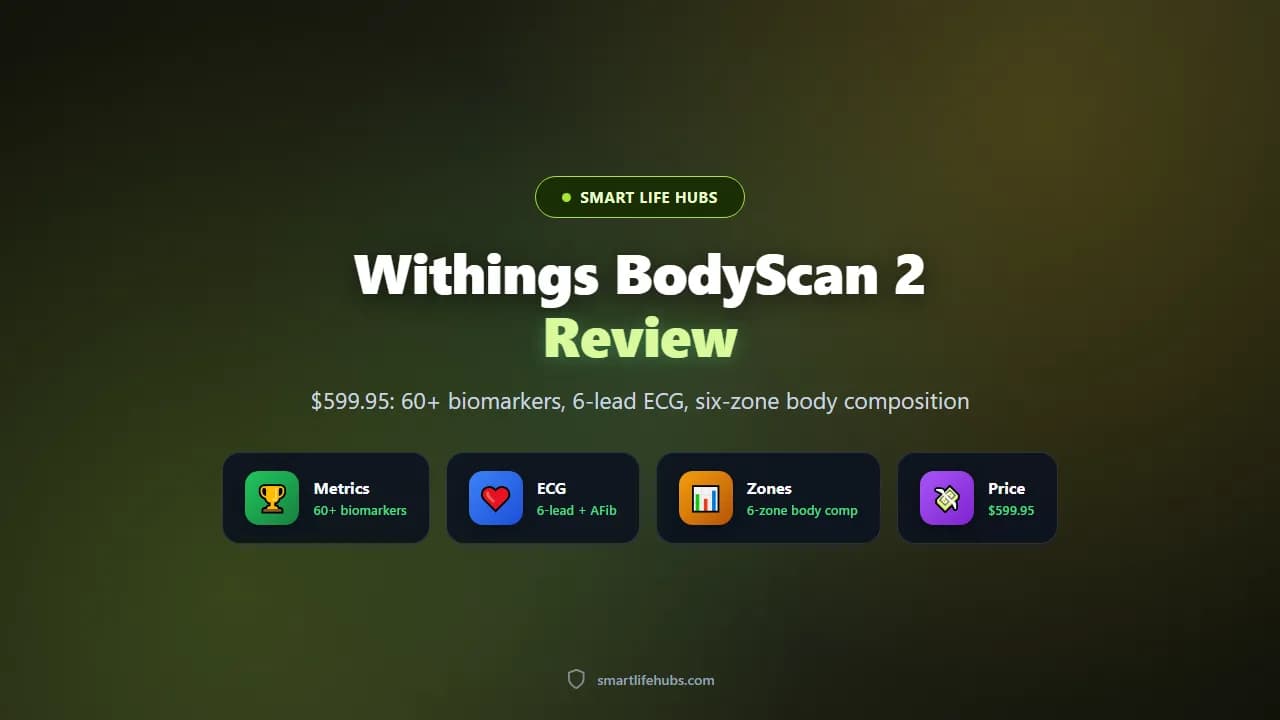
The Withings BodyScan 2 is the most ambitious home scale ever made, and it costs $599.95. You step on barefoot, pull up a retractable handle, and in 30 seconds it measures your weight and body composition, or in a 90 second weekly scan it adds a six-lead ECG, blood oxygen, arterial stiffness, vascular age, basal metabolic rate and a nerve health score. Withings counts more than 60 biomarkers, split across six body zones, and the results sync over Wi-Fi into the Health Mate app and from there into Apple Health, Google Health, Samsung Health, MyFitnessPal, Strava, Runkeeper and Whoop.
It measures far more than any other scale, and it is built like a premium product. It is also $600, needs a subscription for its full in-app experience, weighs 5.4 kilograms and has a cable running to a handle. If you want a scale that tells you something useful about your training, the Withings Body Comp at about $199 or the Garmin Index S2 at about $149 does that for a fraction of the price. If you want the deepest health picture a bathroom scale can produce, this is it.
A note on the price, because it matters. The product this list expected was a $400 scale. The BodyScan 2 launched in the United States at $599.95, which is $100 more than the first generation and roughly three times the best mainstream alternatives. I pulled TechRadar’s and Tom’s Guide’s reviews, Wired’s and the Irish Times’ testing, and Withings’ published specifications. Where a figure is a claim rather than a measurement, I say so. Prices are as of November 2026.
At a glance
| Product | Best for | Key specs | Price |
|---|---|---|---|
| Withings BodyScan 2 | Best overall, most metrics | 60+ biomarkers, 6-lead ECG, 6-zone composition, handle | $599.95 |
| Withings Body Scan | Best previous generation | Handle, segmental analysis, ECG, nerve health | About $499.95 |
| Withings Body Comp | Best mainstream Withings | Foot platform, segmental BIA, vascular age, no handle | $199 to $230 |
| Garmin Index S2 | Best for Garmin users | 13 metrics, athlete mode, Garmin Connect sync | $149 to $200 |
| Eufy Smart Scale P3 | Best value | 16 metrics, Wi-Fi, unlimited users, no subscription | $80 to $100 |
Withings BodyScan 2 in detail
What it measures
The BodyScan 2 runs four kinds of measurement at once. Electrodes under your feet and in the handle pass a small alternating current through your body to estimate composition. Weight sensors and the pulse in your feet time the pressure wave from your heart to estimate arterial stiffness. An electrode set records a six-lead electrocardiogram that can detect atrial fibrillation. And a small voltage probes the sweat glands in your feet to produce a nerve health score. The app then assembles all of this into more than 60 biomarkers covering body composition, heart, nerves and metabolism.
The six-zone breakdown is the most useful part. Rather than giving you one whole-body number, it measures fat and muscle in your arms, legs, torso and abdomen separately, with visceral fat reported on its own. The Irish Times reviewer found this genuinely informative, because you can see how each region changes over weeks and months rather than watching a single percentage drift.
The two scan modes
There are two routines. A Daily Scan takes about 30 seconds and covers weight, whole-body and segmented muscle and fat, basal metabolic rate, vascular age and pulse wave velocity. A Longevity Scan takes about 90 seconds and adds blood oxygen, nerve system responsiveness and the full ECG, and Withings prompts you to do it once a week. You switch between them using the electrodes on the retractable handle as buttons, and the colour LCD shows the readings as they are taken.
That weekly scan is the feature that justifies the product, and it is also the one that takes getting used to. Wired described simultaneously welcoming and dreading it, which is a fair summary. The 90 seconds are long enough that you will not do it casually, and the ECG and blood oxygen readings are the kind of thing you want a doctor to interpret rather than an app.
Accuracy and the evidence
Withings says the scale is accurate to within 50 grams for weight and that its body fat readings correlate 99 percent with a medical DEXA scan. Those are company figures, and the DEXA correlation in particular is a laboratory result under controlled conditions rather than a guarantee in a bathroom. Independent testing is more measured. TechRadar found the scale accurate across almost all metrics, but reported that the vascular age estimate changed significantly over a couple of weeks, which is exactly the kind of number you should not treat as clinical.
The honest framing is that consumer bioelectrical impedance is good for tracking trends in your own body over time and poor for absolute accuracy on any single day. Hydration, meal timing and exercise all move the numbers. Use it as a trend tool, weigh in at the same time under the same conditions, and ignore day-to-day noise.
Build, battery, and the handle
The hardware is genuinely premium. The platform is glass and reinforced aluminium, 12.8 by 14.1 by 0.7 inches, and it weighs 5.4 kilograms, which is heavy for a scale and makes it awkward to move. A 2.8 inch colour LCD shows readings in real time. The battery is rechargeable lithium-ion over USB-C, with Withings claiming up to a year per charge, so there are no disposable batteries to replace.
The handle is the distinctive part and it is cabled. You pull it up, hold it, and it delivers the hand-to-foot measurement that makes the segmental analysis and the ECG possible. It works, but the cable is a weak point on a $600 product, and it means the scale is not a simple slab you can slide into a cupboard. It supports up to eight users and recognises them automatically.
The subscription
The full in-app experience sits behind Withings+, which costs $9.95 a month or $99 a year, with the first three months free. Some of the headline scores, including Heart Age and Glucose Resilience, are tied to the subscription. The core scale works without it, and Tom’s Guide and Wired both note that you can live without paying, but you lose the deeper trend analysis and some of the metrics that make the purchase feel worthwhile. Budget the first year at roughly $700 rather than $600.
The honest drawbacks
The price is the first problem, and it is not a small one. At $599.95 the BodyScan 2 costs more than most premium foot-to-hand scales and vastly more than a basic platform. The second is the subscription, which is an awkward fit for a product you buy once and use for years. The third is the weight and the cable, which make it a fixture rather than a gadget. The fourth is the thin evidence base: it launched in the United States in 2026, so there is little long-term reliability data and few owners to report on durability. TechRadar also found the vascular age estimate inconsistent enough to be misleading if taken literally.
There is also a question of whether you need any of this. If your goal is to track training, a $149 to $200 scale with athlete mode and good app integration will serve you just as well. The BodyScan 2 earns its price only if you actually want the ECG, the nerve health score and the arterial stiffness estimate, and if you will act on them with a doctor.
How it compares
The original Withings Body Scan at about $499.95 does most of what the BodyScan 2 does, including the handle, the segmental analysis, the ECG and the nerve health score, and it is the better buy if you can find it discounted. The Withings Body Comp at $199 to $230 is a foot-only platform with segmental analysis and vascular age but no ECG and no handle, and it suits anyone who wants Withings quality without the flagship price. The Garmin Index S2 at $149 to $200 is the natural choice for people who live in Garmin Connect, with athlete mode and automatic syncing. The Eufy Smart Scale P3 at $80 to $100 is the best value at any price, with 16 metrics, Wi-Fi and unlimited users and no subscription.
Is the Withings BodyScan 2 worth $599.95?
Buy it if you want the deepest picture a scale can give you. If you are the kind of person who wants an ECG at home, tracks arterial stiffness over time and will take the numbers to a doctor, nothing else in this category comes close.
Buy it if you want segmental data rather than a single number. Six-zone fat and muscle tracking is genuinely more informative than whole-body impedance, and the BodyScan 2 does it well.
Buy the original Body Scan if you can find it cheaper. It keeps the handle, the ECG and the nerve health score and costs about $100 less, so unless the newer biomarkers matter to you, it is the smarter purchase.
Buy the Withings Body Comp if you want Withings quality for less. At $199 to $230 it gives you segmental analysis, vascular age and reliable Wi-Fi sync without the handle or the flagship price.
Buy the Garmin Index S2 if you train with Garmin. At $149 to $200 it files weigh-ins directly into Garmin Connect alongside your training and recovery data, which is more useful than a stack of metrics you have to interpret yourself.
Buy the Eufy Smart Scale P3 if you are on a budget. At $80 to $100 it covers 16 metrics with no subscription and is the best value in the category.
Do not buy it if you only want to track weight and body fat. TechRadar’s BodyScan 2 review concluded the specs justify the cost, but that conclusion only holds if you want the extra data. For a casual view of your health, this is an expensive bathroom accessory.
Think about who else uses it. The BodyScan 2 recognises up to eight users automatically, which makes it workable for a household, but only one person is likely to want the ECG and the longevity scan. If several people want metrics, a cheaper scale with multi-user support gives each of them the basics without a $600 outlay.
Think about the rest of the health kit. Our smart scale roundup covers the alternatives in detail, and our sleep gadget guide covers the rest of the recovery toolkit.
Frequently asked questions
Frequently Asked Questions
6It is $599.95 in the United States, £449.95 in the United Kingdom and €499.95 in Europe. A Withings+ subscription costs $9.95 a month or $99 a year after a three month free trial.
Withings counts more than 60 biomarkers, including weight, six-zone body composition, a six-lead ECG with atrial fibrillation detection, blood oxygen, vascular age, pulse wave velocity, basal metabolic rate, blood pressure insight notifications and a nerve health score.
No for the core scale, but the full in-app experience and some scores, including Heart Age and Glucose Resilience, sit behind Withings+. Budget about $100 a year if you want everything.
Withings claims 50 gram weight accuracy and a 99 percent body fat correlation with DEXA. Independent testing found the metrics broadly accurate but the vascular age estimate inconsistent over a couple of weeks. Treat it as a trend tool rather than a clinical device.
Withings says up to a year per charge on the rechargeable lithium-ion battery, which charges over USB-C.
Yes, if you want an ECG, nerve health data and arterial stiffness tracking at home and you will use it with a doctor. No, if you only want weight and body fat, because the Withings Body Comp or the Eufy Smart Scale P3 does that for a fraction of the price.
The bottom line
The Withings BodyScan 2 is the most capable home scale you can buy. You get more than 60 biomarkers, six-zone body composition, a six-lead ECG with atrial fibrillation detection, blood oxygen, vascular age, basal metabolic rate and a nerve health score, all in a glass and aluminium platform with a colour screen and a year-long rechargeable battery. The weaknesses are the $599.95 price, the $99 a year subscription for the full experience, the 5.4 kilogram weight and cable, and a thin evidence base because it is so new. Buy it if you want the deepest health picture a scale can produce and you will take the data to a doctor. Buy the original Body Scan at about $499.95 if you want most of the same features for less, the Body Comp at $199 if you want Withings quality without the flagship price, the Garmin Index S2 at $149 if you train with Garmin, or the Eufy Smart Scale P3 at $80 if you want the best value. Have you tried a body composition scale? Tell us in the comments.